

I need to talk about what Khaled Hosseini did to me on page 36.
We are barely inside this novel. We have just met Mariam, a fifteen year old girl who has spent her whole life in a kolba on the outskirts of a small Afghan town, raised by a mother who loved her like someone with nothing else to love, and a father who visited on Thursdays and made promises he had no intention of keeping. Jalil has spent Mariam’s entire life keeping her close enough to claim and far enough to ignore. When she finally decides to go to him instead of waiting for him to come to her, she discovers exactly what kind of father he has always been.
We watch Mariam walk to his house uninvited. We watch her sleep outside his gate overnight, curled up on the street, waiting for a man who is on the other side of the wall and will not come out. We watch a driver eventually appear to tell her it would be better if she went home now. She is fifteen. She has done nothing wrong except want to be seen by her father. And then we go home with her. And Nana, her mother, is hanging from the branch of a tree.
I had to put the book down. I am not being dramatic.
What Hosseini does in that moment, and this is what I keep returning to, is that he does not linger. He does not dress the image up or slow down to admire his own sorrow. He gives you the tree, the branch, the girl standing there, and then he moves forward. The restraint is what makes it so devastating. You feel the weight of it more because he refuses to perform it.
Nana’s death sets the entire machinery of the novel in motion. Without it, there is no forced marriage to Rasheed, no Kabul, no collision with Laila, no story. She is the emotional foundation on which everything is built, and she is gone before we fully know her. This is the one place, the only place, where I wanted more. We get her bitterness, her ferocious love for Mariam, her contempt for Jalil and for the world that allowed him to treat her the way he did, but we get less of who she was before all of that. She still lands the way it was intended anyway. The image of her in that tree will not leave you. But she is the one character the novel loves without fully seeing, and in a book this committed to making women visible, that is worth naming.
Before she died, Nana said something to Mariam that the novel never lets you forget. “Like a compass needle that points north, a man’s accusing finger always finds a woman. Always. You remember that, Mariam.” It reads like bitterness when you first encounter it, the words of a woman so wounded by one man that she has made a philosophy out of her pain. But Hosseini is too precise a writer for that to be all it is. He plants that line early and then proceeds to spend the next three hundred pages proving it true, in courtrooms and households and street corners and government decrees, in every scene where something goes wrong and a woman is made to answer for it. By the time you finish this novel you understand that Nana was not bitter. She was simply paying attention. That Mariam did not fully believe her, could not fully believe her, is not naivety. It is what it costs to keep living.
That is what this novel is fundamentally about. Who gets to be seen, who gets to be known, whose suffering registers and whose does not.
Then Laila enters the novel carrying an entirely different life. She has been loved differently, raised differently, taught to imagine a future Mariam was never allowed to imagine. For a while, it feels as though Hosseini is asking us to compare them. He isn’t. They do not begin as friends. They begin as rivals, or at least that is how Rasheed needs them to see themselves, because two women who see each other clearly are a threat to a man whose power depends on their isolation. The way Hosseini charts the slow movement from suspicion to recognition to something that can only be called love is where the novel does its most careful and most beautiful work. These two women become to each other what no one else in the novel manages to be: witness. In a world designed to make women invisible, they refuse to look away from each other.
That relationship is the emotional centre of the novel.
What I liked most is that Hosseini never rushes them towards friendship. He lets them misunderstand each other first. Their relationship is built slowly enough that by the time they begin protecting each other, it feels completely natural.
Rasheed is the husband. And I want to say something careful about how Hosseini writes him, because it would be easy to make a man like this into a monster in the cinematic sense, someone whose evil is legible and almost exciting. Hosseini does not do that. Rasheed is recognisable. He is a man who believes completely in his own authority, who has constructed an entire worldview around his right to control the women in his house, and whose violence is very atmospheric. It recurs the way bad weather recurs. You learn to anticipate it. You brace for it. You build your whole day around avoiding it. Hosseini renders this without flinching and without making it beautiful, which is much harder than it sounds. A lot of writers who take suffering as their subject end up aestheticising it in ways that let the reader breathe easy, that transform pain into something almost pleasurable to read. Hosseini refuses this. He keeps the discomfort exactly where it belongs.
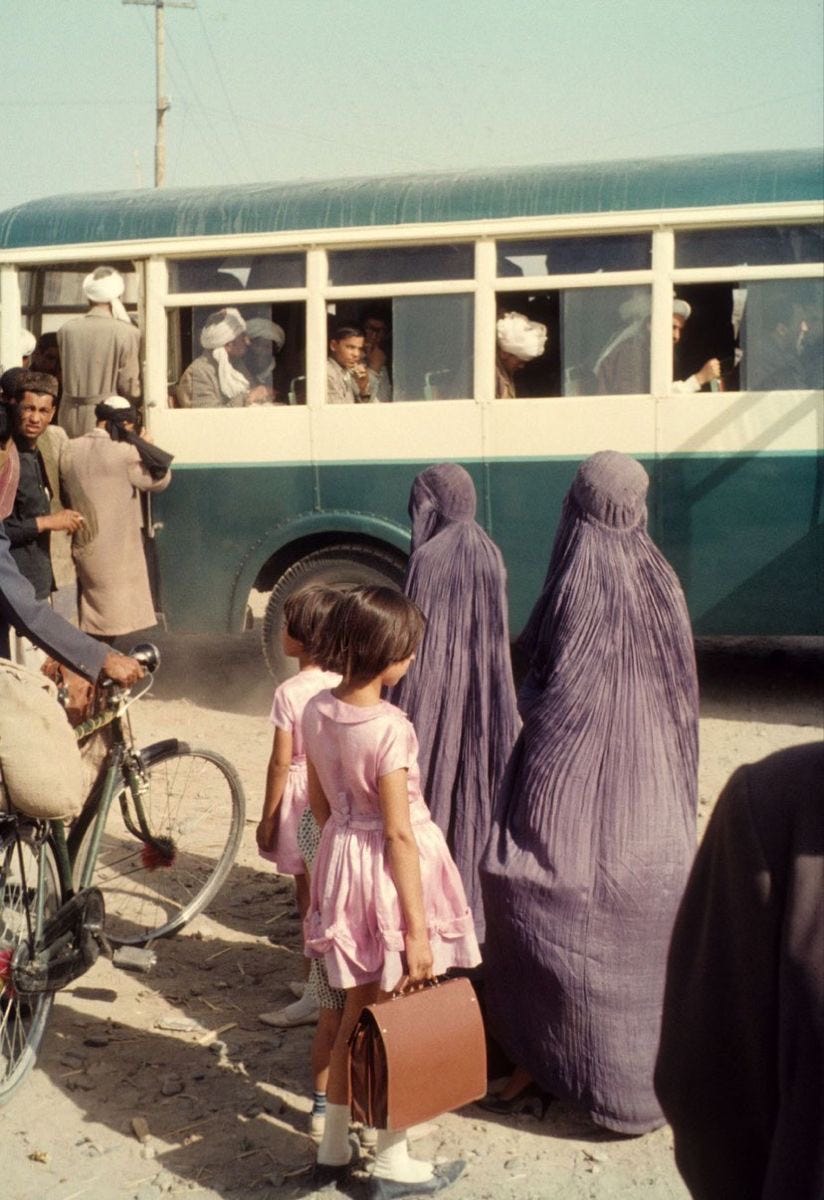
One of the things I admired most was the way Hosseini writes Kabul. He never pauses the novel to explain Afghanistan to the reader. The wars, the Taliban, the checkpoints, the constant shrinking of women’s lives all arrive through the lives of the people already on the page. You don’t learn about history in separate chapters. You experience it the way Mariam and Laila do, as something that keeps entering the house, changing what they can wear, where they can go, how they speak, what they hope for.
I think that’s why the novel never feels like it’s using history as a backdrop for personal drama. Every new law, every bomb, every shift in power reaches into the home until it’s impossible to separate public violence from private violence. Hosseini never has to tell you that. He lets you watch it happen.
The most real and most costly relationships in women’s lives are with each other. And the world is specifically organised to prevent them from knowing this.
It’s one of the few novels I’ve read that treats friendship between women with the same seriousness that other novels reserve for romance. It never asks you to believe that love alone is enough to save them.
I don’t think page 36 is the saddest part of the novel anymore. I think it’s the page that teaches you how to read everything that comes after.
A thousand splendid suns is such a raw and profound book. You read the book and every single word has an impact on you as the reader. The way you described the book is truly heartfelt . I admire people who consume literature with depth and empathy.
Khaleed Hosseini is such a brilliant writer. I regularly think about the letter Mariam's father wrote to Mariam, and how Hosseini finally let us find out about the contents of the letter. My heart is heavy just thinking about it now.
I’ll definitely give it a read. Intriguing review.